
Treasury Warns Shippers Against Iran Hormuz Tolls

Treasury Warns Shippers Against Iran Hormuz Tolls
Washington is trying to keep Iran from turning the world's most important oil chokepoint into a sanctions evasion lane.
WASHINGTON - The Treasury Department warned shipping firms Friday that paying Iran for passage through the Strait of Hormuz could expose U.S. and foreign companies to sanctions, putting banks, insurers and marine operators on notice around a chokepoint that carried about 20 million barrels per day of oil in 2024.
The Office of Foreign Assets Control published an Iran alert titled "Sanctions Risks of Iranian Demands for Strait of Hormuz Passage," according to OFAC's May 1 recent action notice. The warning came the same day Treasury sanctioned three Iranian foreign currency exchange houses and associated front companies it says help Tehran convert oil revenue into money usable by its military, partners and proxies.
For Americans, the issue is not only whether one waterway stays open. EIA data shows Hormuz handled about 20% of global petroleum liquids consumption in 2024, while U.S. sanctions law can reach non-U.S. firms when payments move through U.S. financial pipes, insurance contracts or service providers.
The Story So Far

The Strait of Hormuz sits between Iran and Oman and links the Persian Gulf to the Gulf of Oman and Arabian Sea. The U.S. Energy Information Administration describes it as one of the world's most important oil chokepoints because large volumes move through a narrow route and few alternatives exist if traffic is blocked.
EIA said oil flows through Hormuz averaged 20 million barrels per day in 2024, equal to about 20% of global petroleum liquids consumption. The agency said flows through the strait accounted for more than one quarter of global seaborne oil trade and about one fifth of global liquefied natural gas trade in 2024.
The U.S. exposure is smaller than Asia's direct exposure, but it is not zero. EIA said the United States imported about 0.5 million barrels per day of crude oil and condensate from Persian Gulf countries through Hormuz in 2024, equal to about 7% of U.S. crude and condensate imports and 2% of U.S. petroleum liquids consumption.
What's Happening Now
OFAC's notice says the agency issued an Iran General License W authorizing wind down transactions involving certain persons blocked on May 1, published the Hormuz passage alert and updated the Specially Designated Nationals and Blocked Persons List. The notice lists individuals and companies designated under Iran related executive orders, including persons with links to exchange houses and front companies.
Treasury's separate May 1 release said OFAC designated Opal Exchange, Radin Exchange and Tahayyori and Associates, also known as Arz Iran Exchange, along with associated people and foreign based front companies. Treasury said Iranian exchange houses facilitate billions of dollars in foreign currency transactions each year.
Treasury said Iran primarily settles oil sales in Chinese yuan, then relies on exchange houses to convert those revenues into currencies more readily usable by the Iranian military and its partners and proxies. The department said the latest action was taken under Executive Order 13902, which targets persons operating in Iran's financial sector.
The White House's National Security Presidential Memorandum 2, issued in February 2025, ordered maximum pressure on Iran and directed agencies to deny Tehran all paths to a nuclear weapon and counter what the memorandum called Iran's malign influence. Treasury said the May 1 exchange house sanctions were part of that campaign and said OFAC has sanctioned more than 1,000 Iran related persons, vessels and aircraft since February 2025.
The Conservative View
The Trump administration frames the Hormuz alert as an extension of maximum pressure. Treasury Secretary Scott Bessent said the sanctions campaign is meant to cut off the financial networks that support Iran's military and proxy groups.
"Iran is the head of the snake for global terrorism, and under President Trump's leadership, Treasury is moving aggressively, through Economic Fury, to sever the Iranian military's financial lifelines." - Scott Bessent, U.S. Treasury secretary
"We will relentlessly target the regime's ability to generate, move, and repatriate funds, and pursue anyone enabling Tehran's attempts to evade sanctions." - Scott Bessent, U.S. Treasury secretary
Supporters of the pressure campaign argue that allowing passage fees would create a direct revenue channel for a sanctioned government at the center of a vital oil route. Treasury's release says the exchange house designations are designed to increase costs and reduce revenue for what it calls Iran's destabilizing activities.
The Progressive View
Progressive critics of U.S. policy focus less on the compliance mechanics and more on the broader regional escalation. Progressive International argued in an April briefing that the conflict around Iran and Hormuz shows the limits of U.S. dominance in West Asia and said toll demands, cryptocurrency payment channels and altered shipping behavior reflect a weakened U.S. position.
"The waterway through which around a fifth of the world's oil passes now lies effectively under Iranian control, with the Revolutionary Guards directing ships through Iranian waters around Larak Island." - Progressive International briefing
The group also argued that sanctions and military pressure have raised costs for shippers, insurers and consumers. That critique differs sharply from Treasury's view, but it reflects a broader progressive concern that economic warfare can spread costs beyond the targeted government.
Other Perspectives
Humanitarian agencies warn that transport and fuel shocks do not stay confined to tankers and refineries. UN News said heightened insecurity around key Gulf routes, including Hormuz, is raising basic goods prices and delaying critical supplies.
"Rising transport, food and fuel costs disproportionately affect people who are already living in emergencies, including millions of refugees and displaced people who are among the hardest hit, while also reducing the ability of aid agencies to deliver timely assistance." - Carlotta Wolf, UNHCR spokesperson
UN News said UNHCR has rerouted sea cargo and relied more heavily on alternative land corridors, increasing transport times and costs. Wolf said freight rates from countries where relief items are sourced have risen nearly 18% since the start of the crisis, while UNHCR's global transport provider capacity dropped from 97% to 77% since the start of 2026.
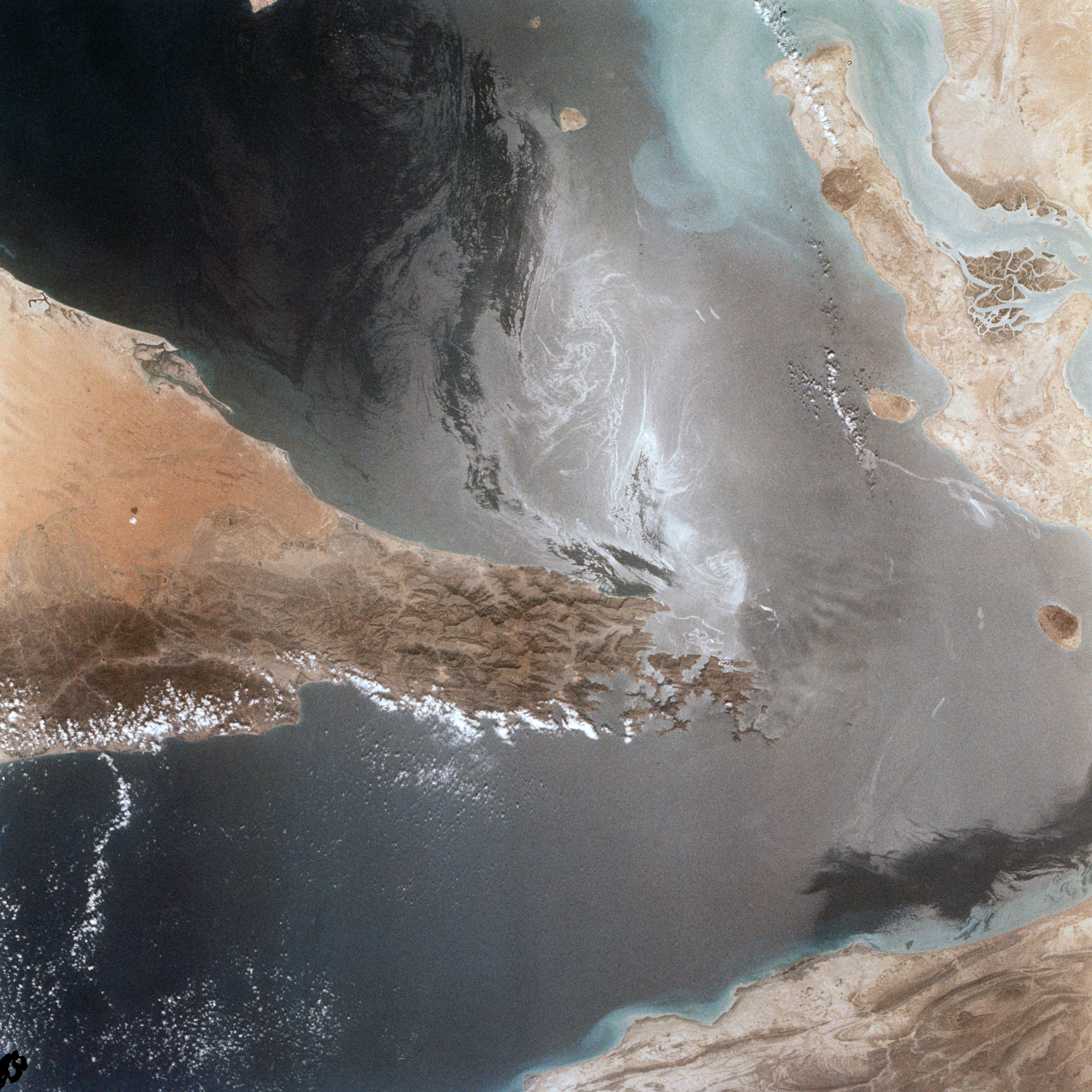 Photo by NASA, via Wikimedia Commons (public domain)
Economic Implications
The sanctions mechanism runs through payment channels first. If a shipper, insurer, bank or intermediary pays Iran for safe passage, OFAC can treat that transaction as sanctions risk conduct when it involves U.S. persons, U.S. services, dollar clearing or designated Iranian parties. The alert is designed to make firms reject not only direct toll payments, but also indirect workarounds that mask the same economic transfer.
The energy mechanism runs through supply risk and shipping cost. EIA said most volumes that transit Hormuz have no practical alternative means of exiting the region, though Saudi Arabia and the United Arab Emirates have pipeline capacity that can bypass part of the route. EIA estimated about 2.6 million barrels per day of Saudi and UAE pipeline capacity could be available to bypass Hormuz during a disruption, far below the 20 million barrels per day that moved through the strait in 2024.
Benchmark prices can move even without a full closure. EIA said Brent crude rose from $69 per barrel on June 12, 2025, to $74 per barrel on June 13 during regional tensions, while noting that maritime traffic had not been blocked at that time. For U.S. consumers, the practical chain is direct: higher tanker risk raises freight and insurance costs, those costs feed into crude and refined product pricing, and gasoline and diesel prices can rise even when U.S. imports from the Gulf remain a small share of total U.S. consumption.
By the Numbers
- 20 million barrels per day: Average oil flow through the Strait of Hormuz in 2024, according to EIA.
- About 20%: Hormuz oil flow as a share of global petroleum liquids consumption in 2024, according to EIA.
- More than one quarter: Hormuz share of global seaborne oil trade in 2024, according to EIA.
- About one fifth: Hormuz share of global LNG trade in 2024, according to EIA.
- 0.5 million barrels per day: U.S. crude and condensate imports through Hormuz from Persian Gulf countries in 2024, according to EIA.
What People Are Saying
"Additionally, OFAC is publishing an Iran-related Alert, 'Sanctions Risks of Iranian Demands for Strait of Hormuz Passage.'" - Office of Foreign Assets Control, May 1 recent action notice
"Because Iran primarily settles its oil sales in Chinese yuan, these exchange houses play a critical role in converting oil revenues into currencies that are more readily useable by the Iranian military and its partners and proxies." - U.S. Treasury Department, May 1 press release
"We will relentlessly target the regime's ability to generate, move, and repatriate funds, and pursue anyone enabling Tehran's attempts to evade sanctions." - Scott Bessent, U.S. Treasury secretary
"In 2024, oil flow through the strait averaged 20 million barrels per day (b/d), or the equivalent of about 20% of global petroleum liquids consumption." - U.S. Energy Information Administration
"Rising transport, food and fuel costs disproportionately affect people who are already living in emergencies, including millions of refugees and displaced people who are among the hardest hit, while also reducing the ability of aid agencies to deliver timely assistance." - Carlotta Wolf, UNHCR spokesperson
The Big Picture
The immediate question for shipping firms is whether any Hormuz passage demand can be routed without touching sanctioned parties, U.S. services or financial systems that OFAC can police. Treasury's warning is meant to make that answer costly before any enforcement action is announced.
The next tests are practical ones: whether OFAC names companies tied to passage payments, whether marine insurers issue new guidance for Hormuz transits, whether Iranian officials publish their own toll rules, and whether oil benchmarks respond to any interruption in traffic. EIA's data shows why the issue matters beyond the Gulf. A narrow shipping lane carries enough oil and LNG to shape fuel, food and transport costs far from the water itself.