
Meta Adds Cryptographic Checks to Encrypted Backup Vaults

Meta Adds Cryptographic Checks to Encrypted Backup Vaults
Menlo Park, California - Meta said Friday that Messenger clients can now verify encrypted-backup infrastructure through over-the-air validation bundles signed by Cloudflare and countersigned by Meta.
The change applies to Meta's hardware security module based Backup Key Vault, which the company said underpins end-to-end encrypted backups on WhatsApp and Messenger. Meta said the vault stores recovery codes in tamper-resistant hardware so backed-up message history can be restored without giving Meta, cloud providers, or third parties practical access.
What Changed
Meta said the new Messenger system changes how clients receive the public keys used to verify the authenticity of the HSM fleet. WhatsApp hardcodes those fleet public keys into the application, according to Engineering at Meta, which means a new key set generally needs an app release.
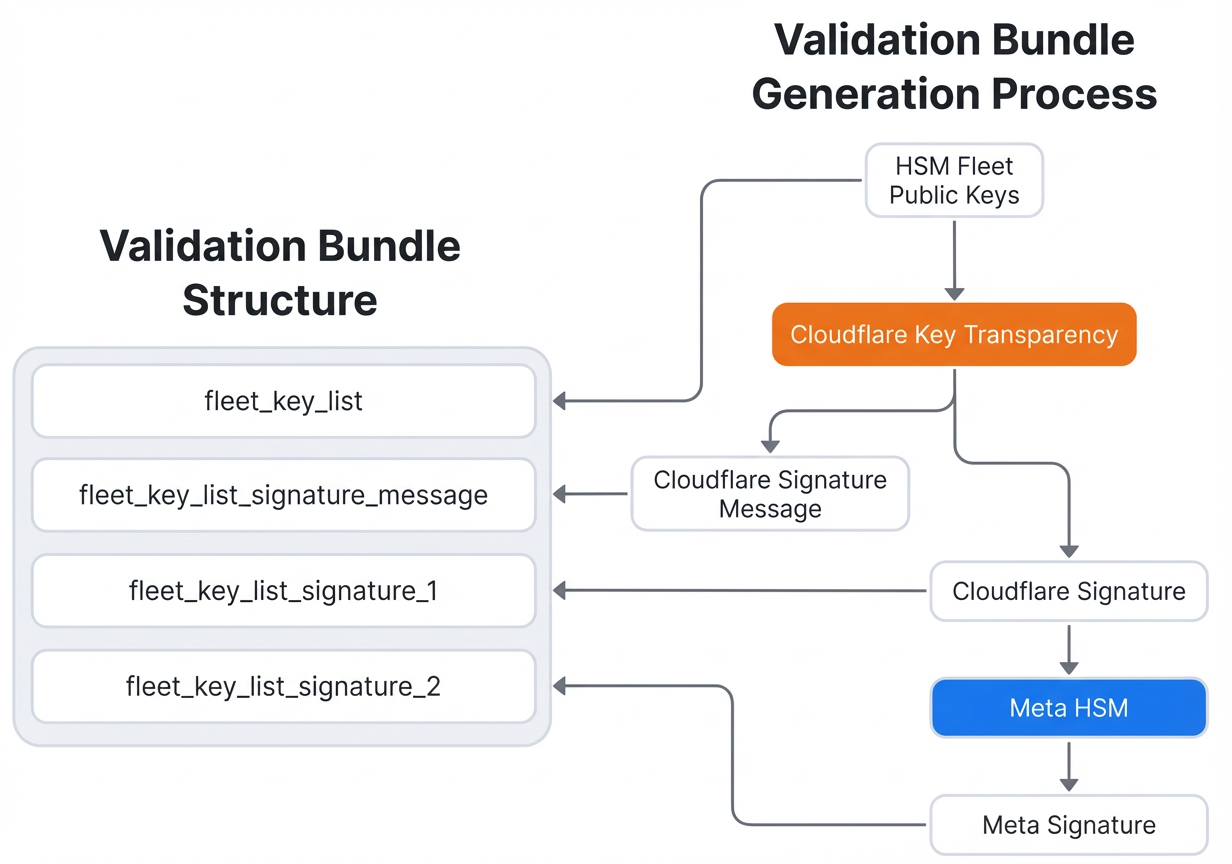
Messenger now receives the fleet public keys as part of the HSM response, according to Meta's May 1 engineering post. Meta said the keys arrive inside a validation bundle signed by Cloudflare and countersigned by Meta, while Cloudflare keeps an audit log of every validation bundle.
The bundle verifies the public keys for the HSM fleet before a client establishes a session, according to Meta. In plain English, Messenger can check that it is talking to the intended backup-key hardware, rather than relying only on keys baked into an older app build.
Meta also said it will publish evidence of secure deployment for each new HSM fleet. The company said those deployments are rare, typically happening no more than every few years.
How the Vault Works
WhatsApp's 2021 encrypted-backup design gives users two ways to protect backup data, according to Engineering at Meta. A user can keep a 64-digit encryption key manually, or the user can protect the backup with a password that retrieves the encryption key from the HSM-based Backup Key Vault.
Meta said the vault enforces password verification attempts and can make the key permanently inaccessible after a limited number of failed attempts. That design is meant to reduce brute-force guessing, where an attacker tries many passwords until one works.
The company said the HSM-based vault is geographically distributed across multiple data centers and uses majority-consensus replication.
That architecture matters because message content and backup keys are different security problems. End-to-end encryption protects messages while they move between sender and recipient devices. Backups create a second target, because a copy of message history may sit off device and may need to be restored later.
About Meta said in March 2024 that Messenger's secure storage lets encrypted chat history be saved remotely or locally, and that users can access it through a six-digit PIN or by storing a virtual key in Google Drive or iCloud. The new HSM update sits underneath that user-facing recovery flow.
The User Stakes
Meta's privacy claim is direct: the company says the recovery code is inaccessible to Meta, cloud storage providers, and third parties. If the architecture works as described, a user can restore a backed-up chat history without turning the backup provider into a readable archive of private messages.
The Electronic Frontier Foundation has argued that encryption is central to private communication. In a December 2024 review of encryption policy fights, EFF said privacy advocates had pushed Meta for years to make end-to-end encryption the default option in Messenger, and said the group filed a brief opposing Nevada's attempt to force Meta to make encrypted systems less secure.
EFF has also warned that backups and notification systems can expose messages when surrounding device and cloud systems are not protected. In April 2026, the group said cloud backups that are not end-to-end encrypted could create access points for providers or law enforcement demands.
For ordinary users, the tradeoff is practical. Stronger backup encryption can reduce access by Meta, Apple, Google, attackers, and government investigators, but it also makes recovery more dependent on a user's PIN, password, passkey, manual key, or the integrity of audited hardware systems.
The Child-Safety Objection
Child-safety advocates have warned that default end-to-end encryption can make it harder for platforms to detect and report child sexual exploitation. The National Center for Missing and Exploited Children's Global Policy Program says end-to-end encryption should not be adopted without technical solutions or other strategies to prevent, detect, disrupt, and report child sexual exploitation.
NCMEC's policy page says the CyberTipline received reports of 7 million fewer incidents in 2024 than in 2023, and said the likeliest factor behind the drop was Facebook's implementation of end-to-end encryption.
Meta's May 1 post does not address child-safety scanning or law-enforcement access. It addresses backup-key authenticity, fleet deployment transparency, and the technical proof that Messenger clients receive when they validate HSM public keys.
What People Are Saying
"Fleet keys are delivered in a validation bundle that is signed by Cloudflare and counter-signed by Meta, providing independent cryptographic proof of their authenticity." - Engineering at Meta, May 1, 2026
"Transparency in the deployment of our HSM fleet is essential to demonstrating that the system operates as designed and that Meta cannot access users' encrypted backups." - Engineering at Meta, May 1, 2026
"WhatsApp will know only that a key exists in the HSM. It will not know the key itself." - Engineering at Meta, Sept. 10, 2021
"There is no backdoor that works only for the good guys." - Electronic Frontier Foundation, Dec. 19, 2024
"E2EE will lead to fewer reports, but it will not lead to fewer victims." - Survivor quoted by the National Center for Missing and Exploited Children's Global Policy Program
 Photo: Meta, via Engineering at Meta (company press image, fair use for news reporting)
The Big Picture
Meta's update is narrow, but it lands inside a larger fight over encrypted communications on US platforms. Privacy advocates want systems that keep message history unreadable to platforms and cloud providers. Child-safety groups want platforms to preserve detection paths for abuse. Companies such as Meta are trying to prove that recoverable backups do not have to become readable backups.
The next test is evidence. Meta said it will publish proof for each new HSM fleet deployment, and said users can verify those deployments through the whitepaper's audit steps. The May 1 post did not include a separate independent audit report, so the technical claim rests on Meta's architecture description, Cloudflare's signing role, and the public evidence Meta says it will publish when new fleets are deployed.