Musk Takes Stand in Federal Trial Accusing OpenAI of Stealing a Charity

Musk Takes Stand in Federal Trial Accusing OpenAI of Stealing a Charity
The case in Oakland federal court asks whether OpenAI's $180 billion conversion to a for-profit empire violated promises Sam Altman and Greg Brockman made when Elon Musk wrote the early checks.
OAKLAND, Calif. - Elon Musk took the witness stand at the Ronald V. Dellums Federal Building Tuesday and Wednesday and told a nine-person advisory jury that the people he funded to build a non-profit AI lab a decade ago turned the lab into one of the most valuable private companies on earth and kept the money. The trial in Musk v. Altman is the first time a U.S. federal jury has been asked to decide whether OpenAI's pivot from a 501(c)(3) nonprofit to a public-benefit corporation worth more than $180 billion broke promises that the founders made to early donors and the public.
The case is captioned Musk v. Altman et al., 4:24-cv-04722-YGR, before Judge Yvonne Gonzalez Rogers, an Obama appointee who sits in the Oakland courthouse. Musk's plaintiffs include himself, his family-office and Neuralink colleague Shivon Zilis, and his AI company xAI. The defendants include Altman, OpenAI co-founder Greg Brockman, OpenAI itself, Microsoft, LinkedIn co-founder Reid Hoffman, and Microsoft executive Deannah Templeton.
The stakes for Americans are direct. Musk is asking the court to direct roughly $130 billion in damages back to OpenAI's nonprofit foundation, to remove Altman and Brockman from the OpenAI board, and to disgorge profits earned by the for-profit subsidiary. The case is being treated as a precedent on whether U.S. charitable trust law constrains how nonprofit AI labs can be converted into private investment vehicles.
The Story So Far
OpenAI was incorporated as a 501(c)(3) nonprofit on December 11, 2015. According to the August 5, 2024 federal complaint and OpenAI's own public statements, Musk donated more than $44 million to the lab between 2015 and 2020 and recruited several of its first researchers, including former Google DeepMind scientist Ilya Sutskever. Musk resigned from the OpenAI board in February 2018.
In March 2019 OpenAI created a "capped-profit" subsidiary, OpenAI LP, that allowed the lab to take outside investment while telling donors the change served the same humanitarian mission. Microsoft made a $1 billion investment that July, and the partnership grew through 2023 to a reported $13 billion in cash and Azure compute.
In November 2023 the OpenAI nonprofit board fired Altman, then reinstated him within five days after most of the company's research staff threatened to follow him to Microsoft. The episode triggered a board reshuffle that Musk's amended complaint cites as the moment "the nonprofit ceased to govern in fact."

Musk filed his first lawsuit in San Francisco Superior Court on February 29, 2024, alleging that Altman and Brockman induced his donations through false promises about OpenAI's open-source mission. He withdrew the state-court suit on June 11, 2024, and refiled in federal court on August 5, 2024 with broader claims, including breach of charitable trust, unjust enrichment, fraud, and racketeering.
On November 14, 2024, Musk's lawyers filed the First Amended Complaint, adding Microsoft, Reid Hoffman, and Deannah Templeton as defendants and adding Sherman and Clayton Act antitrust claims. In March 2025 Judge Gonzalez Rogers denied Musk's motion for a preliminary injunction that would have halted the for-profit conversion, but allowed the underlying breach-of-trust claims to proceed.
In May 2025 OpenAI announced it would abandon a full for-profit conversion. The restructuring completed in October 2025 created OpenAI Group PBC, a Delaware public-benefit corporation, with the OpenAI Foundation nonprofit retaining roughly 26 percent ownership. The valuation crossed $180 billion in subsequent private funding rounds, according to filings cited in the October 17, 2025 OpenAI motion for summary judgment.
On January 15, 2026, Judge Gonzalez Rogers largely denied that summary judgment motion. Five core claims survived to trial: breach of charitable trust, unjust enrichment, breach of fiduciary duty against Altman and Brockman, reasonable reliance on misstatements, and Microsoft's aiding and abetting of the alleged breach. The court has barred punitive damages, leaving disgorgement and equitable remedies as the surviving paths to relief.
On April 25, 2026, four days before opening statements, Musk's lawyers voluntarily dropped fraud and constructive fraud claims to streamline the trial.
What's Happening Now
Jury selection completed Monday, April 27. Opening statements ran Tuesday morning. Musk took the stand later that day and continued under cross-examination Wednesday.
Judge Gonzalez Rogers structured the trial in two phases. The first is a liability phase before a nine-person advisory jury whose verdict is non-binding. The judge will issue the final ruling, expected by mid-May. The trial is scheduled to run two to four weeks.
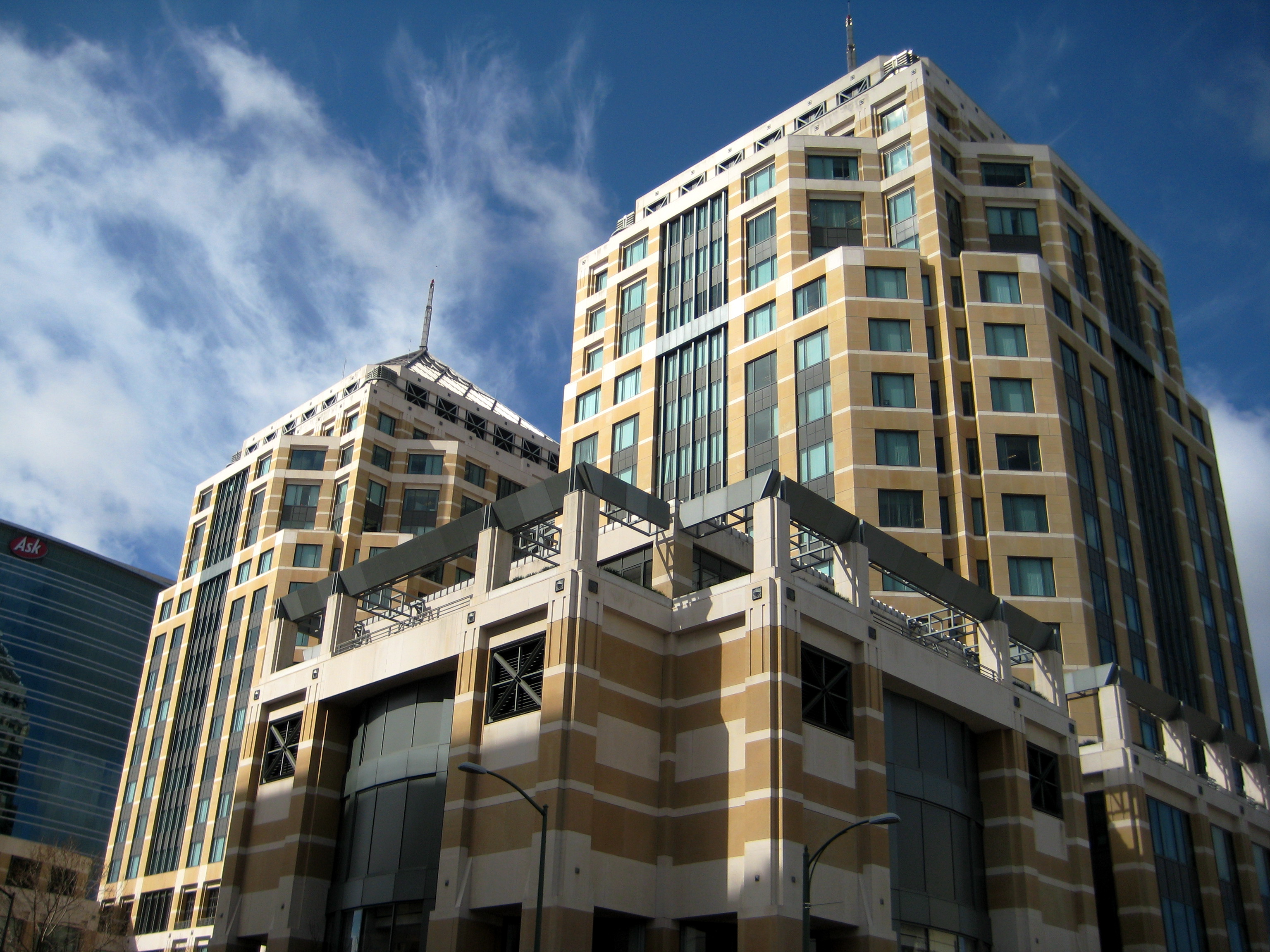 The Ronald V. Dellums Federal Building in Oakland houses Judge Yvonne Gonzalez Rogers's courtroom. Photo by V Smoothe, via Wikimedia Commons (CC BY 2.0).
Musk's lead trial attorney, Steve Molo of MoloLamken LLP, told jurors in his opening that "we are here today because the defendants in this case stole a charity." Molo described the 2022 OpenAI-Microsoft deal as a "game-changer" that violated "every commitment" OpenAI made to Musk and to the public. He compared the for-profit pivot to a museum store deciding to sell off a Picasso collection that the museum had been entrusted to display.
OpenAI's lead trial counsel, William Savitt of Wachtell, Lipton, Rosen & Katz, told the jury: "We are here because Mr. Musk didn't get his way with OpenAI." Savitt said Musk had walked away from the lab in 2018 after his demands for control or a Tesla merger were rejected, that Musk "sat on his claims for years," and that the present lawsuit is anti-competitive interference because Musk now runs a direct rival in xAI. "Because he's a competitor, he'll do anything he can to attack OpenAI," Savitt told jurors.
Documentary evidence introduced by Musk's side included passages from Brockman's personal journal, read aloud in court, that Molo said showed the founders privately discussed converting OpenAI to a for-profit while publicly committing to the nonprofit mission. The journal passages included the line "it would be nice to be making the billions" and the note "cannot say that we are committed to the non-profit. don't wanna say that we're committed."
Musk testified Tuesday and Wednesday that he had been "foolish enough to believe" Altman and that he had "came up with the idea, the name, recruited the key people, taught them everything I know, provided all the initial funding." He told the jury his guess was that artificial general intelligence "will probably be smarter than any human" within a year and that "if you have somebody who's not trustworthy in charge of AI, I think that's very dangerous."
Outside court, Musk posted on X on April 26: "Scam Altman and Greg Stockman stole a charity. Full stop." Judge Gonzalez Rogers admonished Musk in chambers on Tuesday morning that his social-media commentary about the trial would "only make things worse" and warned that a gag order remained an option if the posts continued.
Musk's Case
Musk's surviving claims rest on charitable trust law, not antitrust. The argument runs in three steps.
First, Musk's $44 million in donations were committed to a 501(c)(3) charitable purpose. He took a tax deduction for them, and OpenAI accepted them as charitable contributions. Under California charitable trust doctrine, those funds, and the assets they helped create, remain bound to that charitable purpose.
Second, Altman and Brockman owed fiduciary duties as nonprofit directors to advance that charitable mission. Diverting OpenAI's research, code base, and brand value into a for-profit subsidiary that has now reached a $180 billion valuation, the complaint alleges, breached those duties.
Third, Microsoft is alleged to have aided and abetted the breach by structuring its $13 billion investment around the for-profit subsidiary while knowing the underlying assets had been built with charitable funds. Reid Hoffman and Deannah Templeton are named for sitting on or observing the OpenAI board while holding overlapping positions at Microsoft, an arrangement Musk's complaint frames as an interlocking directorate that facilitated the alleged conversion.
The relief Musk seeks is structured as a return to nonprofit governance, not a payout to himself. Damages of approximately $130 billion would be directed to the OpenAI Foundation. Altman and Brockman would be removed from the OpenAI board. Profits earned by the for-profit subsidiary would be disgorged into the foundation's coffers under the court's equitable powers.
OpenAI's Defense
OpenAI's defense, set out in the redacted October 17, 2025 motion for summary judgment and reinforced in opening statements, is structured around three counter-arguments.
First, Musk himself wanted a for-profit. OpenAI has published email exchanges from 2017 and 2018 that the defense will argue at trial show Musk pushing for OpenAI to merge with Tesla or for Musk to take personal control. In a March 5, 2024 statement, the company wrote: "As we discussed a for-profit structure in order to further the mission, Elon wanted us to merge with Tesla or he wanted full control." When that arrangement was rejected, OpenAI argues, Musk left the board and later founded xAI.
Second, the founders never promised to keep OpenAI's research open-source forever. OpenAI cited a 2016 email from chief scientist Ilya Sutskever, which it says was acknowledged by Musk: "As we get closer to building AI, it will make sense to start being less open. The Open in openAI means that everyone should benefit from the fruits of AI after its built, but it's totally OK to not share the science." Musk replied: "Yup."
Third, the defense argues Musk lacks standing. Charitable trust enforcement under California law typically rests with the state attorney general, who has not joined the lawsuit. Musk's donations, the defense contends, were charitable gifts for which he took tax deductions, not investments that entitle him to demand a particular use of the resulting assets.
Microsoft's separate motion to dismiss the antitrust counts, filed February 4, 2025, called Musk's RICO and Sherman Act claims "devoid of factual specificity and substantiation." Most of those claims were narrowed pretrial; the surviving Microsoft exposure is the aiding-and-abetting count.
The Federal Trade Commission filed a Statement of Interest amicus brief earlier in the case to flag concerns about the OpenAI-Microsoft relationship, but it did not take a position on the trust claims now at trial. The brief is in the public record on ftc.gov.
Other Perspectives
Twelve former OpenAI employees filed an amicus brief in April 2025 supporting Musk's view that the company's pivot violated commitments made to early staff. The brief argued that the founders' public statements about safety and openness were a recruitment tool that materially affected their decisions to join.
Antitrust scholars have noted that the surviving claims are unusual. Most high-profile tech disputes turn on Sherman Act monopolization or merger review under Clayton Act Section 7. Musk's case is closer in legal structure to disputes over donor intent in higher-education endowments and museum collections, which the trial court will analyze under California charitable trust precedents rather than federal antitrust doctrine.
A libertarian reading of the case would focus on whether nonprofit-to-for-profit conversions, common in healthcare, education, and now AI, should be governed by donor expectations or by board discretion. If Musk wins on the charitable trust theory, the precedent could constrain similar conversions across the U.S. nonprofit sector.
The Israeli, European, and Chinese AI ecosystems are watching for a different reason. OpenAI's research outputs underpin a substantial share of U.S. AI commercial development, and Microsoft's compute partnership with OpenAI is one of the most strategically significant industrial relationships in the U.S. tech sector. A judgment that forces unwinding or restructuring of the OpenAI-Microsoft arrangement would alter the competitive landscape for AI training and inference globally.
Economic Implications
The U.S. financial stakes are concentrated in three places: OpenAI's $180 billion private valuation, Microsoft's roughly $13 billion in committed investment plus its Azure compute partnership, and the secondary market for OpenAI employee equity that has made the company a major source of paper wealth for technical staff in the San Francisco Bay Area.
A ruling that compels disgorgement of for-profit subsidiary profits to the OpenAI Foundation would not necessarily reduce the company's enterprise value, but it would shift who captures that value. Microsoft's accounting for its OpenAI partnership has been disclosed in 10-Q filings throughout 2024 and 2025; an adverse trust ruling would force a reassessment of how Microsoft values the partnership and how it accounts for the obligations the for-profit subsidiary owes to the foundation.
The reasonable reliance and breach-of-fiduciary counts could also affect how venture capital structures future investments in nonprofit-affiliated AI labs. Anthropic, which is structured as a public-benefit corporation rather than as a nonprofit-with-subsidiary, has avoided this exact legal exposure but operates under similar mission constraints. Other AI labs that grew out of nonprofit structures, including the Allen Institute for AI, will track the trial's outcome closely.
For U.S. consumers and small businesses, a Musk victory that forced OpenAI to redirect roughly $130 billion to its nonprofit foundation would not change ChatGPT pricing in the near term, but it would change the legal architecture under which OpenAI products are sold. Pricing discipline at OpenAI Group PBC is already shaped by competition from Anthropic, Google, Meta, and xAI, and that competitive pressure is unlikely to ease regardless of the trial's outcome.
The cascade analysis here is grounded in two historical analogs. The Hershey Trust dispute in Pennsylvania, in which the state attorney general and the Hershey School trust clashed over the proposed sale of Hershey Foods Corporation in 2002, ended in a court-ordered preservation of the trust's controlling stake. The TIAA-CREF and Princeton conflict over donor intent, settled in 2008, established that donor expectations can constrain nonprofit asset use even decades after the original gift. Both cases show that courts, not just attorneys general, can enforce charitable trust commitments when the underlying facts are clear.
By the Numbers
- $180 billion - OpenAI's private valuation as cited in the October 2025 motion for summary judgment.
- $130 billion - Damages Musk's lawyers seek to direct to the OpenAI Foundation.
- $44 million - Musk's reported total contribution to OpenAI between 2015 and 2020.
- $13 billion - Microsoft's reported cumulative investment in OpenAI since 2019.
- 26 percent - Approximate ownership stake the OpenAI Foundation retains in OpenAI Group PBC after the October 2025 restructuring.
- 9 - Members of the advisory jury empaneled April 27, 2026.
- 5 - Surviving claims at trial (breach of charitable trust, unjust enrichment, breach of fiduciary duty, reasonable reliance, aiding and abetting).
- 2 to 4 weeks - Expected duration of the trial under Judge Gonzalez Rogers's schedule.
What People Are Saying
"Ladies and gentlemen, we are here today because the defendants in this case stole a charity."
Steve Molo, lead trial attorney for Elon Musk, opening statement on April 28, 2026
"We are here because Mr. Musk didn't get his way with OpenAI. Because he's a competitor, he'll do anything he can to attack OpenAI."
William Savitt, lead trial counsel for OpenAI, opening statement on April 28, 2026
"They're going to make this lawsuit very complicated, but it's very simple. It's not OK to steal a charity."
Elon Musk, plaintiff, testimony on April 28, 2026
"If you have somebody who's not trustworthy in charge of AI, I think that's very dangerous."
Elon Musk, plaintiff, testimony on April 28, 2026
"As we discussed a for-profit structure in order to further the mission, Elon wanted us to merge with Tesla or he wanted full control."
OpenAI, public statement at openai.com/index/openai-elon-musk, March 5, 2024
"As we get closer to building AI, it will make sense to start being less open. The Open in openAI means that everyone should benefit from the fruits of AI after its built, but it's totally OK to not share the science."
Ilya Sutskever, OpenAI co-founder and chief scientist, in a 2016 email exchange released by OpenAI
The Big Picture
The next test is whether Judge Gonzalez Rogers's final ruling treats OpenAI's nonprofit origin as a constraint on its present operations or as a historical fact that does not control how its current public-benefit corporation is governed. The advisory jury's verdict will signal which way the court is leaning, but the binding ruling rests with the bench.
For Americans, the issue is no longer abstract. OpenAI products are embedded in U.S. workplace software, education, healthcare, and government procurement. Microsoft's accounting for its OpenAI partnership flows into one of the largest U.S. publicly traded companies. If the foundation recovers the disgorgement Musk's lawyers seek, the legal architecture under which OpenAI operates would be reshaped. If OpenAI prevails, the precedent will give other nonprofit-to-for-profit conversions in healthcare, education, and AI a clearer path forward.
The trial is expected to wrap by late May. Pressure points to watch include further documentary evidence from depositions of Altman, Brockman, Microsoft chief executive Satya Nadella, and Hoffman; the testimony of plaintiff expert Stuart Russell on AI safety; the testimony of damages expert Paul Wazzan; and any developments in California Attorney General oversight of OpenAI's restructuring, which remains a separate regulatory matter outside this courtroom.
People's Voice Media will update this article as the trial progresses.