Xi Says World Has Reached a New Crossroads in Trump Meeting
BEIJING - Chinese President Xi Jinping warned that the world has reached "a new crossroads" during formal remarks on U.S.-China relations, using a meeting with President Donald Trump to frame the relationship between the two powers as a test of whether rivalry can be managed without a wider crisis.
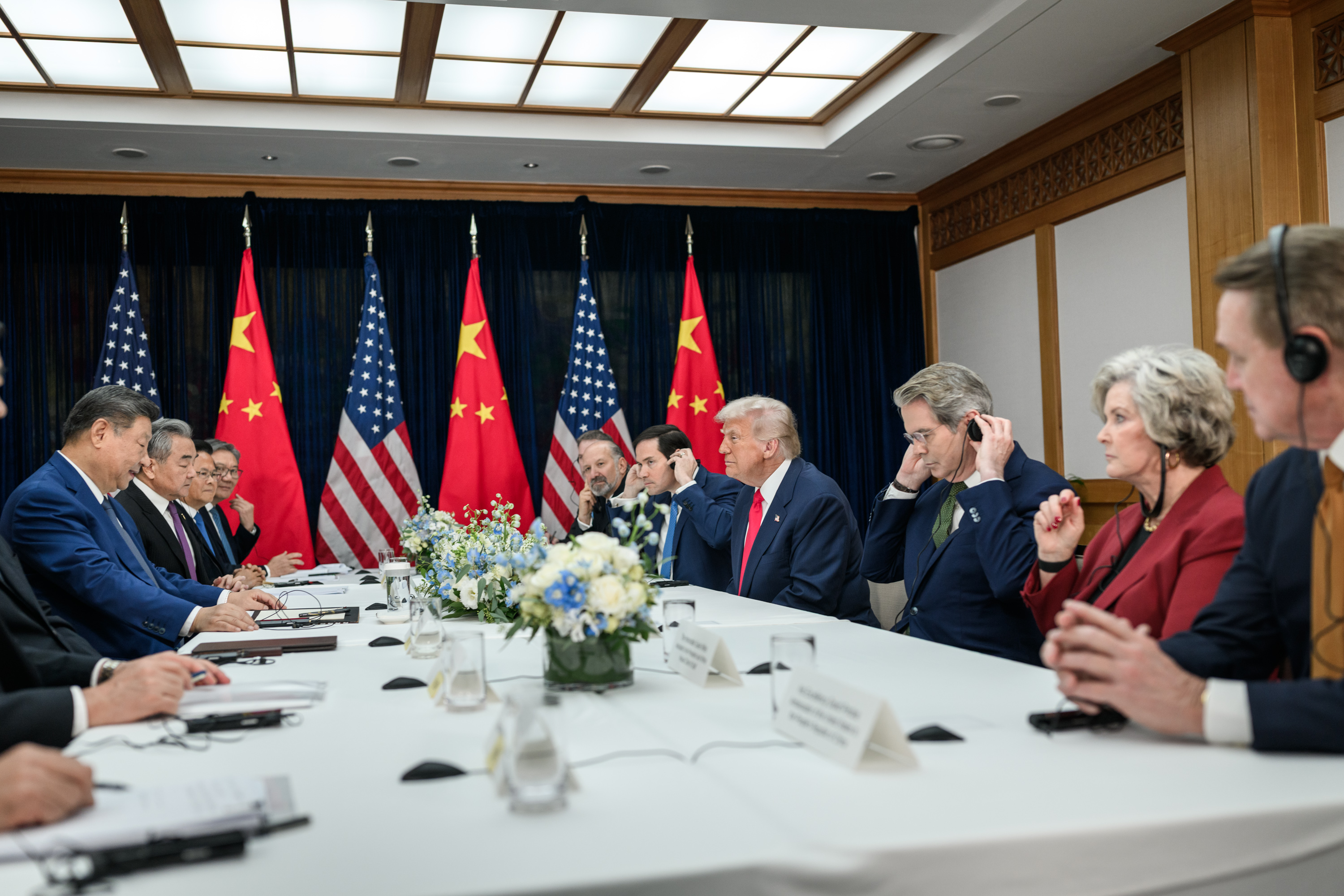
The submitted video shows Xi seated at a formal meeting table, speaking through an interpreter as microphones sit in front of him. The setting was ceremonial, but the language was not casual. Xi described a global environment shaped by accelerating change, instability and pressure on the two largest economies to decide whether they can keep competition from becoming confrontation.
"Currently, transformation not seen in a century is accelerating across the globe and the international situation is fluid and turbulent. The world has come to a new crossroads." - Xi Jinping, according to the submitted video transcript.
The line matters because it places the Trump-Xi meeting inside a larger argument Beijing has been making all day: that Washington and Beijing are not merely holding another diplomatic photo opportunity. They are trying to manage a relationship with consequences for Taiwan, trade, technology controls, fentanyl enforcement, Iran pressure, supply chains and global markets.
Xi Framed the Meeting as a Test of Leadership
Xi opened the clip by saying the whole world was watching the meeting. That was not an exaggeration. A U.S.-China rupture would not remain a bilateral dispute. It would move through allied security planning, shipping routes, semiconductor supply chains, energy markets, defense budgets, banking compliance and consumer prices.
He then put the burden directly on the two leaders. The transcript shows Xi asking whether China and the United States can overcome what he called the Thucydides trap, a phrase often used to describe the danger of conflict between a rising power and an established power.
"Can China and the United States overcome the Thucydides trap and create a new paradigm of major country relations?" - Xi Jinping, according to the submitted video transcript.
That question is the core of the clip. Xi was not announcing that the rivalry had ended. He was saying the two governments now have to decide whether the relationship becomes a managed contest or a destabilizing break.
The Chinese Foreign Ministry readout from the same summit used similar language around strategic stability. It also made clear that Taiwan remains the most dangerous flashpoint. Beijing's readout said Xi called Taiwan the most important issue in China-U.S. relations and warned that mishandling it could put the entire relationship in jeopardy.
The Crossroads Runs Through Taiwan, Trade and Supply Chains
The public tone of the summit has been softer than the policy agenda underneath it. Other clips from the Beijing setting have shown Trump praising Xi and saying the two countries have a "fantastic future" together. Xi, in a separate clip, credited meetings and phone calls with Trump for keeping relations generally stable. Those messages are useful for both governments, but they do not remove the hard issues.
Taiwan remains the most immediate security test. China's Foreign Ministry said Xi warned that if the Taiwan question is handled properly, the bilateral relationship can have overall stability. If not, the ministry quoted him as saying the two countries could have clashes and even conflicts.
For American readers, that is not an abstract line. Taiwan sits at the center of advanced semiconductor production, Indo-Pacific military planning, allied confidence and global shipping risk. A crisis around the island would affect defense spending, insurance costs, electronics supply, data-center buildouts, autos and inflation-sensitive goods.
Trade is the second pressure point. The United States and China remain deeply connected through goods flows, manufacturing inputs, consumer products and strategic industries, even as Washington tries to reduce dependence in critical sectors. That is why summit language about stability has economic value only if it leads to working channels that can manage tariffs, export controls, industrial policy, intellectual property and market access.
Washington Entered the Meeting With Its Own Risk List
The U.S. side has publicly framed the China relationship as both a strategic challenge and a relationship that must be managed. Secretary of State Marco Rubio said in a State Department transcript that China is the most important relationship in the world because of the size and power of both countries. He also tied the meeting to Taiwan, intellectual property, trade dependence and Chinese support for Iran.
"In the case of the Indo-Pacific, Taiwan, and so forth, it's not in China's interest or anyone's interest for there to be any sort of forced change in the status quo. I think stability there is very important." - Secretary of State Marco Rubio, State Department transcript.
Rubio also said the United States cannot depend on China or any country for 100 percent of anything it needs. That point connects the diplomacy to factories, ports, customs planning, defense production, medical supplies, battery materials and telecommunications equipment. A summit can lower uncertainty if it creates predictable channels. It cannot solve the exposure by itself.
Iran adds another layer. Rubio said Chinese support for Iran would be detrimental to the relationship, according to the State Department transcript. That links the Beijing meeting to sanctions enforcement, oil flows, shipping lanes, regional deterrence and financial compliance. A stable Trump-Xi channel could help Washington press Beijing on those issues. It could also become a political liability if warm language is not matched by measurable movement.
The Clip Captured the Summit's Central Tension
Xi's "crossroads" line is powerful because it sits between ceremony and warning. The image is calm: a leader seated at a polished table, speaking in measured language through a formal interpreter. The substance is sharper: the relationship between Washington and Beijing is being presented as a choice point for the wider world.
That makes the video useful beyond the transcript. Viewers can see the controlled official setting and hear the cadence of Xi's remarks. The delivery reinforces the message that Beijing wants the summit read as a leader-level moment, not a lower-level negotiation over a single deliverable.
The danger is that ceremonial stability can outrun policy substance. If the meeting produces follow-through on military communication, fentanyl precursor enforcement, trade access, export controls and Iran pressure, the crossroads language will look like part of a serious risk-management effort. If the summit produces only flattering clips and mismatched readouts, the same language will look like diplomatic theater.
What Comes Next
The next test is whether the two governments describe the same outcomes after the cameras leave. Matching language on Taiwan stability, trade reciprocity, fentanyl, Iran and military channels would suggest that the leader-level tone has a working track underneath it. Conflicting readouts would suggest that each side is using the meeting to project responsibility while preserving maximum room for disagreement.
The second test is whether companies and allies see reduced uncertainty. Businesses need predictable tariff paths, export-license rules, sanctions guidance and market-access signals. Allies need confidence that Washington can talk to Beijing without weakening deterrence. Taiwan needs reassurance that stability language does not become pressure to accept Beijing's terms.
The third test is whether the Trump-Xi channel survives the next shock. A naval incident, a Taiwan Strait exercise, a tariff threat, an Iran sanctions dispute or a technology-control fight could quickly test the summit's language. Xi's warning that the world has reached a crossroads gives both governments a public benchmark. Either the meeting becomes evidence that rival powers can manage pressure, or it becomes the line people replay when the relationship gets worse.
For now, the clip captures the central fact of the Beijing summit: the United States and China are trying to show restraint while openly acknowledging that the stakes are global. Xi did not say the rivalry is over. He said the two leaders have to answer whether it can be contained.