AWS Opens MCP Server For AI Agents With IAM Guardrails
Amazon's cloud unit is turning AI-agent access into a managed endpoint, with IAM controls, CloudTrail logs, and sandboxed scripts around more than 15,000 AWS API actions.
SEATTLE - Amazon Web Services said its AWS MCP Server is now generally available, giving AI coding agents a managed way to work against real AWS accounts without routing every action through a local terminal.
AWS described the product as a remote Model Context Protocol server that exposes a fixed tool set for agents, connects API calls to existing IAM credentials, and records activity through CloudWatch and CloudTrail. The release matters because coding agents are moving from code suggestions into infrastructure operations, where a mistaken command can create cost, security, and compliance problems inside a customer's cloud account.
The company is not releasing a model, changing training-time scaling, or opening model weights. AWS is adding an access layer around agents that already exist. The architecture change is about how agents reach tools and cloud APIs at inference time: an MCP-compatible client calls a managed AWS endpoint, and AWS maps the request into IAM-backed actions, documentation retrieval, or sandboxed script execution.
The Story So Far
Model Context Protocol, or MCP, is an interface that lets an AI application discover tools, call them with structured inputs, and receive structured outputs. The Agent Toolkit for AWS page says MCP provides a standardized way for agents to connect to external tools and data sources, and AWS is using that interface as a gateway into cloud accounts.
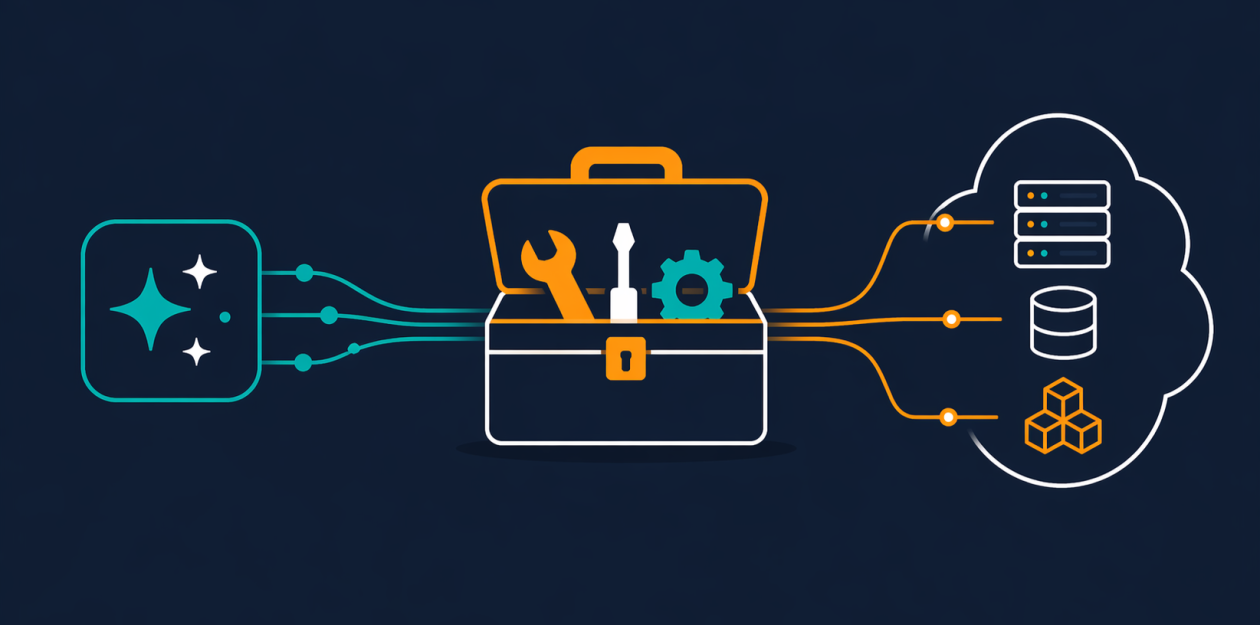
AWS said the server is part of Agent Toolkit for AWS, a set of products that includes the MCP Server, skills, and plugins for coding agents. The company's stated problem is straightforward: AI coding assistants can write and inspect infrastructure, but their cloud knowledge can be stale and their use of local command-line tools can make agent actions hard to separate from human actions.
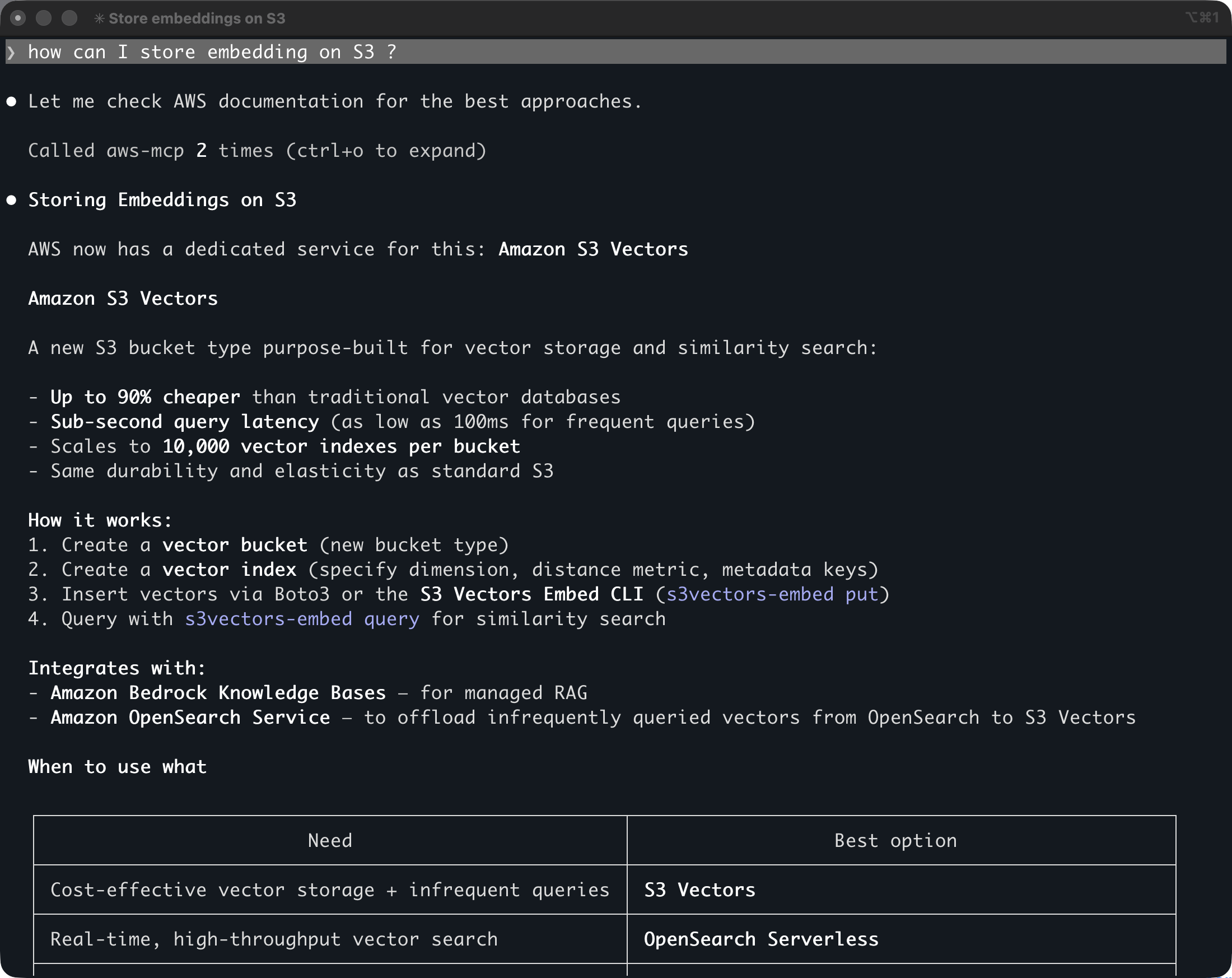
The AWS News Blog gave one example tied to training data. AWS said an Anthropic Opus 4.6 model running through Claude Code did not initially know about Amazon S3 Vectors because the model's knowledge cutoff was May 2025 and the service entered preview after that date. AWS said the same client, when connected to the AWS MCP Server, could call documentation-search tools and find current service guidance at query time.
That distinction is important for the tech beat. AWS is not claiming that the model learned new facts. AWS is saying the agent can fetch current documentation during the task, which is an inference-time retrieval and tool-access pattern rather than a training-time update.
What's Happening Now
AWS said the generally available server gives agents access to AWS through a small set of tools. The most important is call_aws, which AWS said can execute more than 15,000 AWS API operations using the customer's existing IAM credentials. The same server also exposes search_documentation and read_documentation, which AWS said retrieve current AWS documentation and best practices at query time.
"The call_aws tool executes any of the 15,000+ AWS API operations using your existing IAM credentials." - Sebastien Stormacq, AWS News Blog
AWS said general availability adds IAM context keys, so customers can write policies that apply specifically to agent-initiated actions. The Agent Toolkit for AWS page identifies aws:CalledViaAWSMCP as the context key for those policies. In practice, that means an organization can try to separate what a person may do directly from what an agent may do through the MCP server.
AWS also added run_script, a tool that lets an agent write a short Python script and execute it server-side in a sandbox. AWS said the sandbox inherits IAM permissions but has no network access and does not expose the user's local file system or shell. That feature is meant to let an agent chain multiple AWS API calls, filter results, and compute an answer in one round trip rather than spending multiple model turns on single API calls.
"The sandbox inherits your IAM permissions but has no network access, so you can give an agent the ability to process data without giving it access to your local file system or a shell." - Sebastien Stormacq, AWS News Blog
AWS said the server is available through endpoints in US East, Northern Virginia, and Europe, Frankfurt. AWS said those endpoints can make API calls to any AWS Region. The company also said there is no additional charge for the AWS MCP Server itself, while customers still pay for AWS resources they create and any applicable data transfer costs.
The Enterprise Control View
AWS is making its clearest case to enterprises that want agents to help with cloud operations but cannot accept a black box sitting on top of production infrastructure. The AWS MCP Server User Guide says the managed server gives agents access to AWS through MCP, and that agents authenticate through existing IAM credentials when they execute API calls, run Python scripts, or follow curated skills.
"All capabilities are available through a single endpoint with CloudWatch metrics and IAM-based access controls. CloudTrail logs all API calls for audit visibility." - AWS MCP Server User Guide
That audit trail is the product's main governance pitch. The Agent Toolkit for AWS page says that when agents execute AWS commands through a local terminal, organizations have no clear way to distinguish agent actions from human actions, enforce organization-wide policies, or audit what happened. AWS says CloudWatch metrics under the AWS-MCP namespace expose MCP server activity separately from direct human calls, while CloudTrail captures API calls for the account record.
For compliance and security teams, the attractive part is not that agents get more power. It is that the power has a narrower control point. AWS said enterprise customers can use IAM policies or AWS Organizations Service Control Policies to allow a human user to perform mutating operations while restricting the MCP server to read-only actions.
The IAM background matters here. The AWS IAM User Guide says policies define permissions and that AWS evaluates those policies when an IAM principal makes a request. It also says permissions in the policies determine whether a request is allowed or denied. The MCP server sits on top of that existing control plane instead of replacing it.
The Developer View
Developers get a different tradeoff. AWS said the server works with Claude Code, Kiro, Cursor, Codex, and any MCP-compatible client. That gives teams a common route for agent-assisted AWS work, rather than a separate integration path for each editor or coding assistant.
AWS said documentation retrieval no longer requires authentication, while API calls and sandboxed scripts still depend on IAM credentials. That split matters because a developer can ask an agent to retrieve current AWS guidance without granting account access, then use authenticated actions only when the task needs real resources or account data.
AWS also said Agent Toolkit skills are curated instructions and reference materials maintained by AWS service teams. The stated goal is to help agents follow AWS best practices for tasks where they commonly make mistakes. In technical terms, that is not the same as making the base model more capable. It is a runtime guidance layer that changes the information and procedures available to the agent during a task.
The risk for developers is scope creep. A tool that can call more than 15,000 API actions is powerful even when the surface is mediated by MCP. If a user's IAM credentials are too broad, the agent's effective reach can still be too broad. AWS's announcement reduces the need for local shell access and adds policy hooks, but it does not remove the customer's responsibility to set least-privilege permissions.
Other Perspectives
From a security standpoint, the release is best read as a governance layer, not a safety guarantee. AWS says the server can separate human and agent permissions, provide CloudWatch metrics, and leave CloudTrail records. Those controls help after customers write the right IAM and Service Control Policy rules. They do not prove that an agent's proposed action is correct, cost-effective, or safe for production.
From an open-tools standpoint, MCP compatibility matters because AWS is not limiting the server to one model vendor or one editor. AWS listed Claude Code, Kiro, Cursor, Codex, and any MCP-compatible client. That gives enterprise buyers a way to standardize cloud access while still choosing among agent clients.
From a cloud-platform standpoint, the strategic stakes are larger than one server. U.S. cloud providers are trying to turn coding agents from demos into infrastructure operators. The limiting factor is no longer whether a model can draft a command. It is whether a company can tell which actor made the change, limit what the actor may touch, and reconstruct what happened later.
Economic Implications
AWS did not announce a separate price for the MCP Server. The AWS News Blog says there is no additional charge for the server itself, and that customers pay only for AWS resources they create and any applicable data transfer costs. That pricing choice lowers the direct adoption barrier, but it also shifts the economic risk to resource creation, data transfer, and operational mistakes that occur through normal AWS billing.
The product also changes the cost equation for agent workflows. AWS said run_script can combine multiple API calls and compute results in a single round trip, which the company says is faster and more context-efficient than making one API call at a time. For teams paying for model tokens, fewer turns can reduce inference costs, but AWS did not publish an independent benchmark or dollar estimate in the announcement.
For AWS, the business logic is indirect. If agents become a common interface for provisioning, troubleshooting, and managing cloud workloads, the cloud provider that controls the safe access path gets a stronger position in enterprise AI operations. The immediate revenue still comes from AWS resources, data transfer, and related cloud services, according to AWS's pricing statement for the MCP Server.
By the Numbers
- More than 15,000 AWS API operations can be executed through the
call_awstool, according to the AWS News Blog. - More than 300 AWS services are reachable through the MCP Server's API coverage, according to Agent Toolkit for AWS.
- Two endpoint Regions, US East, Northern Virginia, and Europe, Frankfurt, are available for the AWS MCP Server, according to AWS.
- Zero additional charge applies to the MCP Server itself, while AWS resource and data transfer charges still apply, according to the AWS News Blog.
What People Are Saying
"I’m happy to announce the general availability of the AWS MCP Server, a managed remote Model Context Protocol (MCP) server that gives AI agents and coding assistants secure, authenticated access to all AWS services through a small, fixed set of tools." - Sebastien Stormacq, AWS News Blog
"When agents execute AWS commands through a local terminal, there's no way to distinguish agent actions from human actions, enforce organization-wide policies, or audit what happened." - Agent Toolkit for AWS
"Permissions in the policies determine whether the request is allowed or denied." - AWS IAM User Guide
"For enterprise customers, the AWS MCP Server provides a clear separation between human and agent permissions." - Sebastien Stormacq, AWS News Blog
The Big Picture
The AWS MCP Server gives AI agents a managed route into AWS accounts, but its safety depends on the same basics that already govern cloud security: least-privilege IAM, policy review, CloudTrail monitoring, cost controls, and staged deployment. AWS has added a control surface for agent access. Customers still have to decide which agents get access, which actions are allowed, and where human review is required.
The next test is adoption inside real enterprise workflows. AWS said the server works with major coding agents and MCP-compatible clients. If teams use it for read-only troubleshooting, documentation retrieval, and controlled staging tasks, it could become a standard agent-access layer. If teams connect broad credentials to production accounts without tight IAM rules, the same 15,000-action surface can turn a productivity tool into an operational risk.